Understand the places you visit
Santo Domingo History for Visitors: Understanding the City Beyond Its Monuments
Connect Santo Domingo’s landmarks with Taíno heritage, colonial power, African heritage and Dominican independence, then choose a thoughtful historic walk.
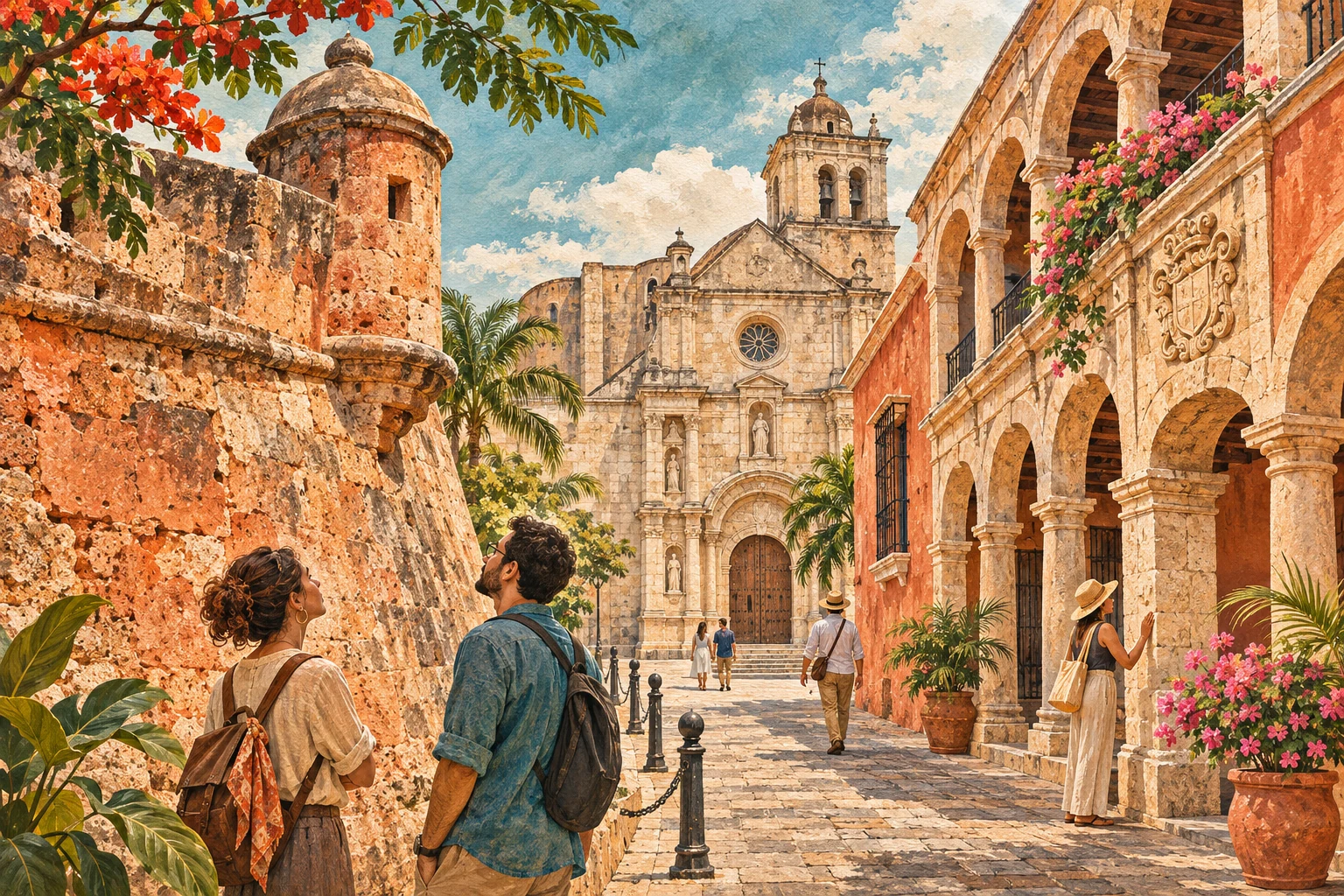
Begin before the colonial city
Hispaniola was inhabited by Indigenous peoples, including Taíno communities, before Columbus arrived in 1492. The founding of a European settlement was not the beginning of the island’s human history. Disease, forced labour and violence devastated Indigenous communities, but that does not mean their heritage disappeared. Approach Taíno objects and traditions as part of a continuing Caribbean story, not simply a preface to colonial buildings.
Separate the island’s history from the city’s development
The early Spanish settlement developed on the east bank of the Ozama in the late fifteenth century. In 1502 Nicolás de Ovando moved the city’s institutions to the west bank, where today’s Colonial Zone preserves the historic street pattern. The Colonial Zone guide helps locate the district. Claims about the city’s European colonial ‘firsts’ should not be read as claims that the Americas had no earlier cities or civilizations.
Read buildings as institutions, not just façades
Around Parque Colón and Calle Las Damas, ask what each building did. The cathedral expressed religious authority; Fortaleza Ozama served military power; the Alcázar was associated with Diego Colón’s viceregal household; Casas Reales housed colonial administration. These places reveal different parts of government and society. The museum guide helps choose an interior where you can explore those distinctions instead of treating every stone building as the same attraction.
Ask whose work and experiences are less visible
Colonial wealth and power depended on coercion, including Indigenous forced labour and the enslavement of Africans and their descendants. Their lives, resistance, skills and cultural contributions belong in the story alongside governors and monuments. Ask whose perspective a display or tour includes. Food, music and language can open further questions about living heritage; the Dominican food guide and merengue and bachata article offer different ways to continue exploring, rather than reducing any tradition to one origin.
Distinguish independence from the Restoration
The Dominican Republic proclaimed independence from Haiti on 27 February 1844, after the period of Haitian rule that began in 1822. Juan Pablo Duarte, Francisco del Rosario Sánchez and Matías Ramón Mella are central figures, but the movement involved many others. Puerta del Conde and Parque Independencia connect a visit with national memory. Reannexation to Spain in 1861 and the Restoration War of 1863–1865 are later events: independence and Restoration are not two names for the same struggle.
Tell an old building from a later commemoration
A monument’s subject and its construction date are different questions. Faro a Colón is a modern commemorative building, not a surviving colonial lighthouse. Read the Faro a Colón guide for its purpose and the contested claims surrounding Columbus’s remains. A memorial shows how later generations chose to remember the past; it should not automatically be treated as evidence from the period it commemorates. UNESCO recognition of the Colonial City in 1990 is another later chapter in its preservation.
Turn the context into a manageable visit
Use the one-day itinerary to choose a compact walk around Parque Colón, Calle Las Damas and Plaza de España, with one confirmed museum interior. An independence-focused stop around Puerta del Conde is a deliberate extension, not another name for the riverside route. Keep Faro a Colón as a separately planned journey across the river. Confirm entrances, current access and walking requirements; historical importance does not establish opening hours or step-free access.
Choose the interpretation you want
For a focused historic walk, compare the Colonial Zone Walking Tour; for a wider view of the capital, compare the Colonial and Modern City Tour. Ask whether the guide can discuss Indigenous and African heritage, colonial institutions and independence in your preferred language. Confirm actual interiors, admission and time inside. A place named on a route does not guarantee an exhibition visit, and no short tour can explain every period of Dominican history.
Questions about this itinerary
Did Santo Domingo’s history begin with Columbus?
No. Indigenous peoples lived on Hispaniola before European arrival. The colonial city is one chapter in the island’s longer history.
Are Dominican independence and the Restoration the same event?
No. Independence was proclaimed in 1844; the Restoration War of 1863–1865 followed reannexation to Spain in 1861.
Is Faro a Colón a colonial building?
No. It is a modern commemorative building. Its subject is older than the structure itself.
Do I need a museum or a guide?
Either can add context. Choose by subject, interpretation language and actual access; a sightseeing route does not automatically include museum interiors.
Can I cover all these places in one walk?
Choose a compact Colonial Zone route first. An independence-focused extension needs extra time, and Faro a Colón requires a separate cross-river journey.
Keep planning
Experiences for this itinerary
Explore Santo Domingo with more context
Compare cultural experiences and discuss the history, language and interior visits that matter to you.
Compare Santo Domingo experiences